Dovetail vs Scribe-Fit Corners: How Log Walls Settle
25 October 2026 · 11 min read

A solid log wall settles, shrinks, and moves. The corner joint is where settling, chinking, and airtightness are either managed or exposed. This comparison examines the claim that the corner joint, not the log profile, governs how a wall behaves, and it puts two systems under the same lens: the dovetail joint and the scribe-fit corner. You will learn what a dovetail joint does in a solid log wall, what a scribe-fit corner does, and how they compare side by side on settling, chinking, and airtightness. You will also see which logs and climates point a buyer toward each corner, why the foundation outranks either corner, and what to require in the quote before signing. Western Red Cedar, valued for rot resistance and found primarily in British Columbia, offers a durable material advantage, but it does not remove the need to match the joint to the wall and the climate. By the end, you should be able to read a quote with the corner system, and its re-chinking interval, named clearly.
The Corner Joint, Not the Log Profile, Decides How a Wall Behaves
At Canadian Pride Log and Timber, our position, drawn from more than 35 years in the trade rather than from a published study, is simple: in a solid log wall the corner joint governs how the wall settles, how much chinking gap opens, and how often that chinking needs attention. Treat it as field experience, not a research finding.
The mechanism is straightforward. Solid logs lose moisture after construction and shrink across their width, so every course drops a little. The corner is the only point where two moving walls meet, so whatever the joint does there sets the terms for the entire wall.
The log profile does something else. Round or square, hand-peeled or milled, diameter and taper shape the look, the span and the depth of wood above door and window openings. None of those choices decides whether corners stay tight.
This article compares the two systems on three functional criteria:
Settling. Can the wall move down without tearing itself open.
Chinking demand. How much gap opens, and how often it is refilled.
Airtightness. How well the corner resists air and water infiltration as it moves.
Those criteria are not ours alone. Settling, thermal envelope and infiltration each hold their own sections in the 2022 ICC 400 log construction standard, which confirms the industry treats them as design decisions rather than afterthoughts.
We build both dovetail and scribe-fit corners, so there is no reason to rank either on appearance. The right joint follows your logs and your climate, and the rest of this piece separates them on function.
What a Dovetail Joint Does in a Solid Log Wall
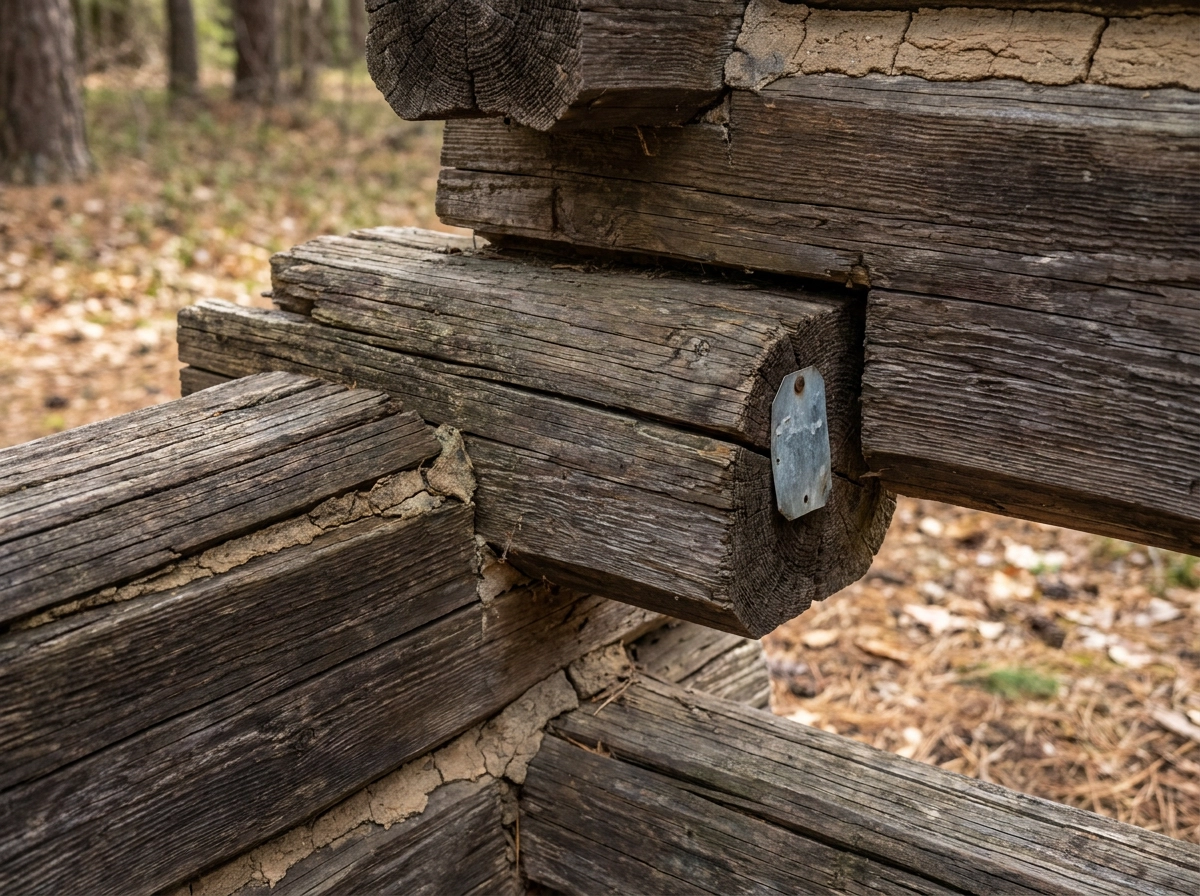
Where a scribed joint fits surfaces, the dovetail works by interlock. The end of each log is cut into a fan-shaped dovetail that widens toward the log end, then seats into a matching notch in the crossing log. The two courses do not simply rest on each other; they lock.
That lock is cut as a slot rather than a pin. As a log dries and shrinks across its width, it can slide downward through the slot instead of being held up on a shoulder. The wall settles as a system, and the corner stays closed, which is the dovetail's core job in a solid log wall.
The widening shape also resists pull-out. Under lateral load, a straight notch can slide apart along the wall line; a dovetail cannot, because the wood behind the notch traps it. That is why dovetail corners hold long stacked walls together.
Settling still opens a gap between courses somewhere. The advantage is not that the dovetail stops movement; it is that the movement stays organised, so the gap is predictable and accessible for chinking rather than random. This article quotes no published settling rate or re-chinking interval; none is supported. Ask your builder to name their own interval in the quote.
Canadian Pride Log and Timber builds dovetail log construction alongside stacked log and post and beam work, so the corner is an installed system, not a theoretical option. Projects such as Marks Dovetail show the joint in service.
What a Scribe-Fit Corner Does in a Solid Log Wall
A scribe-fit corner, sometimes called a chinkless corner, is built the opposite way to a machined interlock: nothing is cut through the log's full width at the corner. Each log is set in place, its underside marked against the irregular top surface of the log beneath, and exactly that profile removed. The wood keeps its structural section at the intersection.
Because every joint follows the actual curve, taper and crown of that specific log, consecutive courses sit in near-full contact along their length, not only at the corner. That continuous bearing is what makes long, hand-fitted walls feasible, and it is what you see in completed scribe-fit work.
On settling, we describe what we observe in our own builds rather than what published research confirms: a scribed wall settles along the length of the fit, and continuous contact is what keeps it tight. Public sources do not document long-term scribe-fit performance, so treat this as company experience, not a verified benchmark.
A scribed joint leaves far less open area for chinking than a notched corner in the same wall. It is also less forgiving: the fit must be cut accurately in the first place, and logs should be dry and stable when fitted.
The trade-off is plain. Scribe-fit is labour-intensive, log-by-log work that favours irregular, large-diameter or hand-peeled logs and long uninterrupted walls, where the continuous fit earns its cost. Examples sit in our wider project portfolio.
Side by Side: Settling, Chinking and Airtightness
Scribe-fit and dovetail manage the same movement differently. Neither is immune to it.
Settling. A dovetail corner directs movement through a machined interlock, keeping the corner locked as courses drop. A scribe-fit corner relies on a continuous hand-cut fit along the log to carry the wall down evenly, spreading that movement through contact rather than geometry.
Chinking. The dovetail concentrates the open gap at predictable, accessible locations. A scribed joint presents far less open area to begin with, so there is less surface to maintain, provided the fit was cut well and the logs were stable when fitted.
Airtightness. Both systems depend on the joint staying in contact as the wall moves. The dovetail keeps contact through geometry; the scribed fit through surface area. Neither guarantees airtightness alone. Shrinkage, poor foundation drainage and failed chinking all open pathways, and corners and construction joints are recognised leak points in log walls (Montana DEQ).
Function | Dovetail corner | Scribe-fit corner |
|---|---|---|
Settling behaviour | Machined interlock stays locked as courses drop | Continuous hand-cut fit carries the wall down evenly |
Chinking demand | Gap concentrates at predictable, accessible points | Less open area, dependent on accurate cut and stable logs |
Airtightness | Contact held by geometry | Contact held by surface area |
Those differences are what the joint contributes. Species choice, log moisture at delivery and foundation condition sit alongside the joint and can outweigh it, so the next two sections matter when weighing a quote.
Which Log and Climate Point a Buyer to Each Corner
The species and climate narrow the decision settling, chinking and airtightness opened.
Western Red Cedar is found primarily in British Columbia's coastal temperate rainforest, and its natural rot resistance is the reason Canadian Pride Log and Timber highlights it for corner applications where log ends face weather and trapped moisture. In the company's experience, Douglas fir brings strength and span, while white pine gives a lighter, more workable log.
Climate tilts the joint further. Wet coastal and high-rainfall regions reward a corner that drains and stays tight, putting rot-resistant cedar and a well-organised chinking line first. Interior climates with wide seasonal swings and freeze-thaw cycles put the emphasis on how the joint handles repeated movement.
Log geometry follows. Large-diameter, irregular or hand-peeled logs with natural crown and taper suit a scribe-fit corner, because the fit follows the wood's actual surface. Milled logs of consistent dimension suit a dovetail joint, whose interlock depends on repeatable geometry from course to course. Long walls favour that locked interlock. Shorter, heavily hand-worked builds are where scribe-fit's continuous contact pays off.
The foundation still outranks the corner.
The Foundation Prerequisite That Outranks Either Corner
Before you weigh a dovetail interlock against a scribed fit, settle the ground the wall stands on. The USFS preservation guide Dovetails and Broadaxes states that a log building needs a foundation that keeps sill logs, spandrel logs and floor joists far enough from ground and moisture to deter decay and insect infestation. That requirement applies to every solid log wall, whichever corner you choose.
Frost heave is a foundation issue, not a corner issue. The same guide notes that masonry or cement foundations which do not extend below the frostline are vulnerable to distortion and settlement from ground heaving during freeze-thaw cycles. No joint geometry compensates for a foundation that moves.
The guide also records that log buildings with cellars are less prone to foundation problems than those built on grade or on crawl spaces, provided the cellar stays dry and ventilated. Treat that as documented general guidance, not a rule for every site.
Two single cases show the risk. Preservation carpenters raised the Sage Creek Cabin 18 inches (about 450 mm) over two weeks using jacks and cribbing. A second documented case found sleepers laid directly on the ground had rotted severely. Both illustrate foundation risk, and neither is a settling or performance benchmark.
Because foundation condition, drainage and frost exposure drive moisture and movement regardless of corner type, settle the foundation question before arguing about the joint. Speak with the team about your site conditions before the corner discussion goes any further.
What to Require in the Quote Before You Sign
With the foundation question resolved, the quote is where the corner joint becomes a commitment rather than an assumption. Require five things in writing.
Name the joint. The proposal should state dovetail corner or scribe-fit corner, alongside the log profile and species. At the intersection of the walls, there should be no ambiguity about what is being built.
Name the re-chinking interval. This article deliberately quotes no figure, because no published source supports one and walls in different climates will not share a single number. Make the builder commit to their own interval in the proposal.
Assign the work. Ask who performs the re-chinking and what access it needs. Long walls and tall gables change maintenance cost, so the answer belongs in the document, not in a verbal assurance.
Raise wet logs. Ask how the builder handles log moisture at delivery and how long the wall is left to settle before final chinking. It is a fair, non-technical question that reveals how the corner was designed to behave.
Confirm cedar species. Western Red Cedar is found primarily in British Columbia; a buyer choosing it should confirm species in the quote.
With those answers written down, the quote becomes a specification you can hold a builder to.
Bringing It Together
The corner joint decides how a solid log wall settles and how often it needs re-chinking. Carry that line into every conversation about a quote, and choose the joint from the log and the climate rather than from appearance.
The filter stays simple. Irregular, hand-peeled or large-diameter logs, and long stacked walls, favour a scribe-fit corner that follows the wood's real surface. Consistent milled logs, and walls where predictable settling and a manageable chinking line matter most, favour a dovetail joint.
Before you sign, three asks belong in writing: the joint named in the quote, the re-chinking interval named in the quote, and confirmation that the foundation keeps sill logs clear of ground and moisture.
Canadian Pride Log and Timber builds both dovetail and stacked log construction and works with red cedar, Douglas fir and white pine, so you can compare the two systems with one builder rather than guessing. That experience includes partnership with First Nations organisations across North America.
One honest note for the closing. The joint-versus-profile framing is the company's field position after 35-plus years of building, and the foundation guidance is documented practice. Treat each accordingly when you interrogate a quote.
Conclusion
The corner joint governs how a solid log wall settles. Match the joint to your logs and your climate, put the joint and the re-chinking interval in writing, and you have the foundation for a straight conversation with any builder.